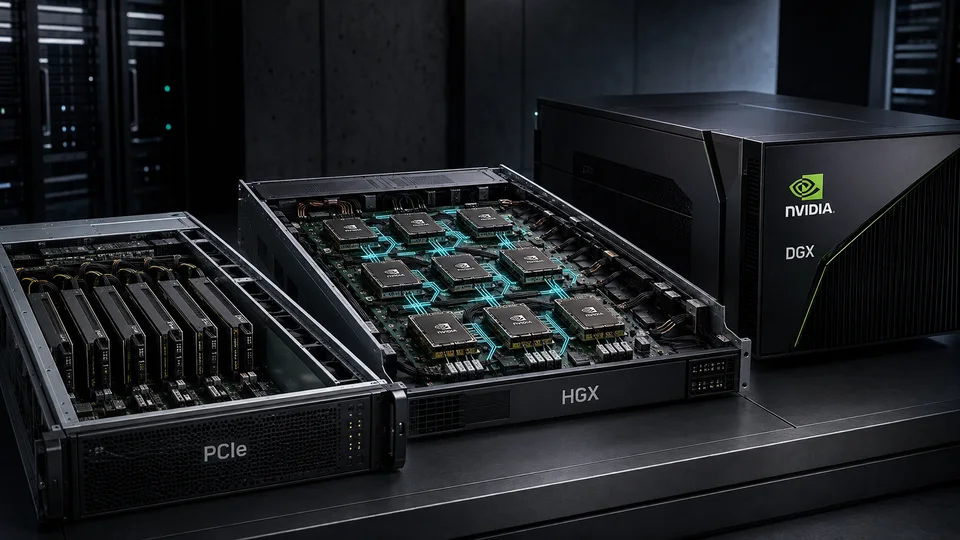
DGX is sometimes used as if it were the technical name for any powerful GPU server. That confusion can turn into an expensive purchasing mistake. A buyer may expect a fundamentally different class of compute performance, when much of the hardware capability comes from an HGX platform that is also available inside OEM systems. The additional value of DGX lies in the complete product: its integration, software, validation and services.
The distinction is especially useful for teams serving open-weight models, building retrieval-augmented generation systems or expanding capacity gradually. Those teams need to establish both whether they need a tightly connected multi-GPU platform and whether they can make practical use of the services sold with it.
Establish what is being quoted
| Option | What it is | Principal value |
|---|---|---|
| DGX | A complete NVIDIA-branded system with hardware, DGX OS, firmware, management tools and integrated support | A validated configuration and a coordinated operational and support model |
| HGX | A multi-GPU compute platform integrated into an OEM server; in the H100/H200 examples here, SXM GPUs, a baseboard, NVLink and NVSwitch | Fast GPU-to-GPU communication for work distributed across several GPUs |
| PCIe GPU server | A server chassis fitted with PCIe add-in cards | Flexibility in card count and type, with options for incremental growth |
The DGX H100/H200 user guide describes an eight-GPU system with CPUs, memory, storage, networking and four NVSwitches. An OEM server based on the corresponding eight-GPU HGX platform can provide the same class of internal GPU fabric. The comparison must account for the complete configurations, but DGX should not be treated as “a faster HGX” simply because of its name.
Part of what a DGX purchase buys is a tested bill of materials, firmware, diagnostics, monitoring and a defined installation and support process. NVIDIA’s DGX software resources describe DGX OS as a customized Ubuntu distribution and explain that components of the software stack can also be installed on standard Ubuntu or Red Hat systems. The economic case for DGX rests on the value of that tested and supported combination.
A model catalog is not enough to justify the system
Access to NVIDIA’s models and tools is sometimes offered as a reason to buy DGX. That argument combines several different products and entitlements. The public NGC Catalog includes containers, models, SDKs and other resources. NVIDIA AI Enterprise adds a commercial software and support offering whose licensing terms need to be evaluated separately.
NVIDIA’s licensing guide lists five-year AI Enterprise subscriptions with H100 PCIe, H100 NVL and H200 NVL GPUs. Activation and the applicable GPU and certified-system conditions still matter. This does not mean that every product carrying an H100 or H200 name grants unrestricted access to every model, nor does it make DGX the only route to an included subscription. Confirm the exact SKU, entitlement, start date and support eligibility in the quote.
For a team working with open-weight models such as Llama, Qwen or Mistral, the underlying model may already be available through a public repository under its own license. An optimized container or supported runtime can reduce installation and maintenance work, but ownership of a DGX is not a general requirement for accessing those model weights.
The useful question is specific: which component of the commercial software and support offering will reduce this team’s operating cost, deployment time or service risk? A long product list does not answer it. If the service uses an existing open-source runtime and internal tooling, the proposed replacement needs a concrete benefit.
Service availability belongs in the same assessment. Registration requirements, support coverage, access to updates and the practical route for hardware returns can vary with the supplier and deployment arrangement. A service that cannot be activated or used has little operational value. Even when every service is available, paying for one the team does not need still requires justification.
HGX needs a workload case of its own
Choosing an OEM HGX system instead of DGX does not automatically make the investment appropriate. The central hardware benefit is the high-bandwidth fabric inside the server. It is useful when a single model or training job is divided across GPUs and collective operations move substantial amounts of data.
Eight independent jobs, each using one GPU, may gain little from NVSwitch. Likewise, serving a model that fits comfortably on one or two GPUs may not benefit enough from an eight-GPU fabric to justify the additional cost. The result depends on model size, concurrency, latency requirements and the execution engine—not simply on whether the application is called AI.
Frameworks such as PyTorch and vLLM, and communication libraries such as NCCL, provide mechanisms for multi-GPU execution. Economical scaling still requires an appropriate parallelism strategy, batch configuration, GPU mapping and measurement. A successful launch on eight GPUs is weaker evidence than a useful improvement in cost per completed job or served request.
Crossing the boundary between servers adds another layer. In the H100/H200 configurations discussed here, NVSwitch provides the internal GPU fabric. Multi-node execution also needs suitable NICs, a compute network, storage and software tuning. The DGX SuperPOD reference architecture treats those as distinct parts of the deployment. Large distributed training and some HPC workloads can justify that investment; independent jobs will not acquire multi-node scaling merely because the necessary cables and switches have been installed.
Choose in two stages
For inference, development, RAG and limited fine-tuning, an expandable PCIe server is often a useful baseline to test. Evaluate HGX when the actual workload needs the combined resources of several GPUs and communication between them materially affects execution time. Benchmark the proposed configurations, including the efficiency gained when moving from two GPUs to four and eight.
Then assess the complete-system offering separately. Compare DGX with supported OEM alternatives, including installation, maintenance effort, software entitlements, support coverage and the price difference. The host platform guide covers the CPU, storage and network requirements that belong in both quotes.
The purchase is justified when the workload uses the hardware capability and the operating team uses the services. Prove those two parts independently. That produces a more defensible decision than selecting a product tier first and trying to find a reason for it afterward.